Sleep Stages and Their Role in Substrate Metabolism
Exploring phase-specific metabolic effects and energy utilization during NREM and REM sleep.
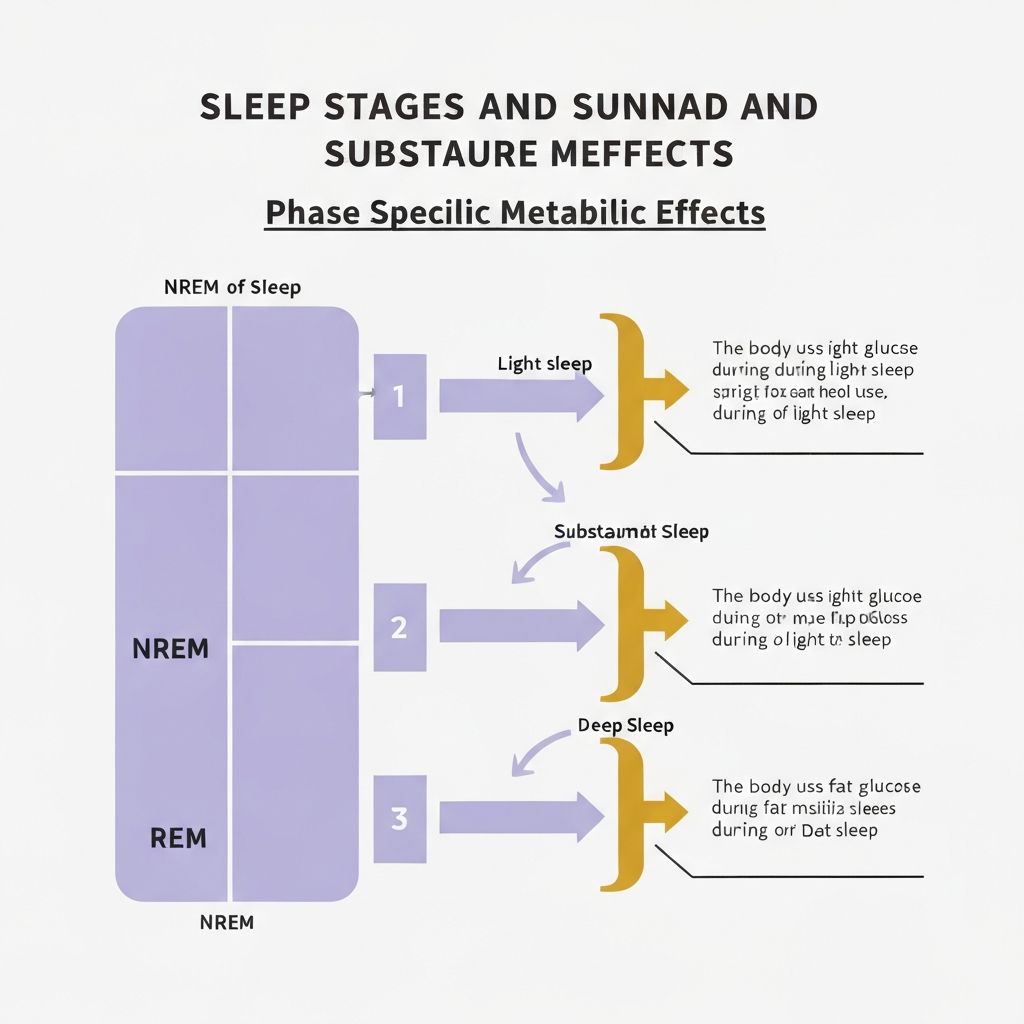
Understanding Sleep Stage Classification
Human sleep is divided into two primary categories: non-rapid eye movement (NREM) sleep and rapid eye movement (REM) sleep. NREM sleep comprises approximately 75-80% of total sleep time and is further subdivided into three stages based on electroencephalographic (EEG) characteristics and sleep depth. NREM Stage 1 represents the transition from wakefulness to sleep, characterized by theta wave activity and reduced muscle tone. NREM Stage 2 comprises the majority of NREM sleep and features sleep spindles and K-complexes on EEG. NREM Stage 3, also termed deep sleep or slow-wave sleep (SWS), exhibits predominant delta wave activity and represents the most restorative sleep stage.
REM sleep accounts for 20-25% of total sleep time in adults and is characterized by rapid eye movements, cortical activation patterns resembling wakefulness, complete motor atonia, and dream mentation. The cyclical alternation between NREM and REM sleep throughout the night, termed the sleep-wake architecture, demonstrates a regular periodicity of approximately 90 minutes per cycle, with greater proportion of deep NREM sleep in early sleep cycles and increased REM duration in late sleep cycles.
Metabolic Characteristics of NREM Sleep Stages
NREM sleep stages demonstrate progressively reduced metabolic rate compared to wakefulness, with metabolic depression becoming more pronounced in deeper sleep stages. During NREM Stage 1, resting metabolic rate decreases approximately 5-10% below waking values. NREM Stage 2 exhibits further metabolic reduction of 10-15%, while NREM Stage 3 (deep sleep) demonstrates the most substantial metabolic suppression, with reductions of 15-30% below waking resting metabolic rate depending on individual factors and measurement methodology.
This metabolic reduction during NREM sleep reflects reduced sympathetic nervous system tone, decreased body temperature, and reduced muscle activation. The reduced metabolic rate is accompanied by preferential utilization of lipids as fuel substrate, with fat oxidation constituting a greater proportion of total energy expenditure during NREM sleep compared to wakefulness. The combination of reduced absolute metabolic rate and increased fat oxidation proportions creates conditions favorable for lipid consumption during sleep, provided sleep duration and quality are adequate.
REM Sleep Metabolism and Cerebral Energy Demands
REM sleep presents a distinct metabolic profile compared to NREM stages. Whole-body metabolic rate during REM sleep approaches waking levels, yet the distribution of metabolic resources differs substantially. Brain glucose consumption increases dramatically during REM sleep, particularly in regions associated with visual processing, emotion, and memory consolidation. Simultaneously, muscle energy demands decrease due to motor atonia, resulting in a redistribution of energy substrates toward neural tissue at the expense of skeletal muscle.
Norepinephrine concentrations are suppressed during REM sleep while acetylcholine levels increase, creating a neurochemical environment distinct from both wakefulness and NREM sleep. This neurochemical milieu influences whole-body substrate utilization patterns. The extended duration of REM sleep in late sleep cycles corresponds to the period of greatest cognitive processing and memory consolidation, reflecting the metabolic demands of these neural processes.
Substrate Preference Across Sleep Cycles
The cyclic alternation between NREM and REM sleep stages throughout the night creates dynamic patterns of substrate utilization. Early in the night, when NREM deep sleep dominates, lipid oxidation predominates and metabolic rate remains suppressed. As the night progresses and REM sleep becomes increasingly prevalent, a shift toward greater carbohydrate dependence occurs in association with increased cerebral glucose demands.
The overall contribution of lipids to total sleep-period energy expenditure depends on the total duration of NREM stages, particularly deep sleep duration. Individuals with adequate deep sleep duration demonstrate sustained lipid oxidation throughout the night, while those with fragmented sleep or reduced deep sleep demonstrate earlier shifts toward carbohydrate dependence and potentially greater absolute and relative carbohydrate consumption during sleep.
Impact of Sleep Stage Disruption on Metabolic Regulation
Conditions that fragment sleep architecture or reduce deep sleep duration—including obstructive sleep apnea, periodic leg movements, insomnia, and circadian rhythm disorders—can substantially alter the distribution of metabolic substrates utilized during sleep. Sleep fragmentation prevents the sustained metabolic suppression and lipid oxidation characteristic of consolidated NREM sleep. Repeated arousals during sleep elevate sympathetic tone, increase norepinephrine concentrations, and promote carbohydrate utilization at the expense of lipid oxidation.
Furthermore, reduced deep sleep duration reduces the duration of maximal metabolic suppression, limiting the potential for substantial lipid consumption during sleep. The cumulative effect of sleep fragmentation and reduced deep sleep is an overall increase in carbohydrate dependence and reduced lipid oxidation during the sleep period, alongside incomplete parasympathetic activation and impaired metabolic recovery.
Limitations and Context: This article presents information on sleep physiology and metabolic processes. The information provided is for educational purposes only and does not constitute personalized recommendations. Individual responses to sleep duration and quality vary substantially based on genetic factors, age, habitual physical activity, and dietary patterns. This content is not intended to replace professional guidance from qualified healthcare providers.
Continue exploring sleep-metabolism research
Discover related articles examining hormonal regulation, circadian rhythm effects, and research evidence on sleep and lipid metabolism.
Return to blog overview